
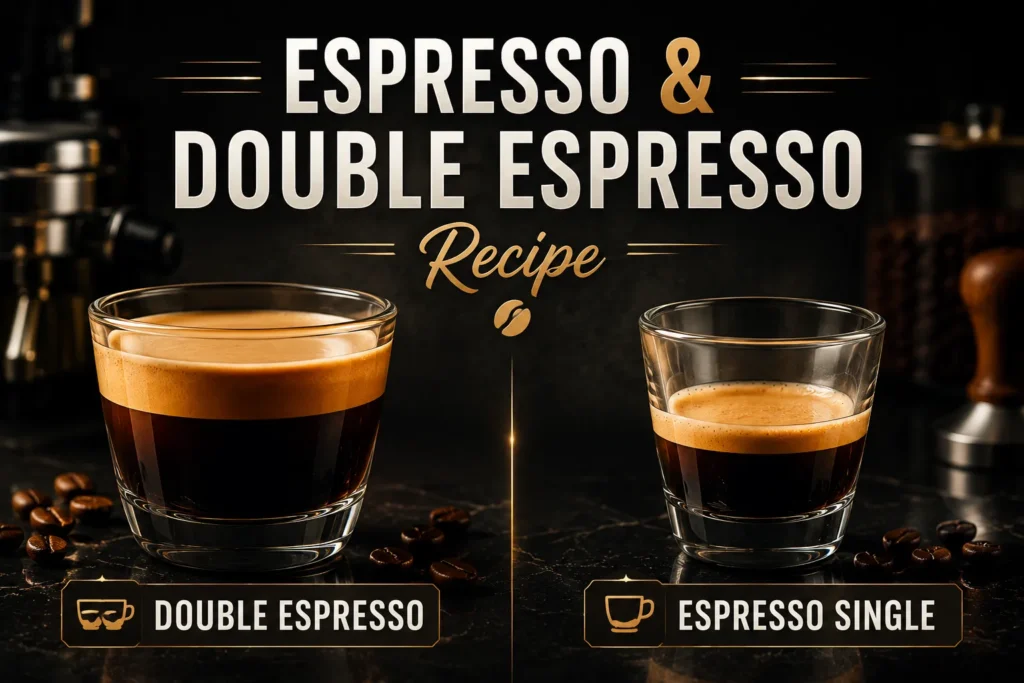
Single Espresso Recipe
- Use 7–9 g of freshly roasted coffee beans. Grind them finely for espresso.
- Place the ground coffee into the portafilter and distribute it evenly.
- Tamp the coffee firmly and evenly to create a level coffee puck.
- Lock the portafilter into the espresso machine and start the shot.
- Aim for approximately 25–30 ml (1 oz) of espresso in 25–30 seconds.
- A well-extracted espresso should have a golden-brown crema on top.
- Serve the single espresso immediately while it’s hot and aromatic.
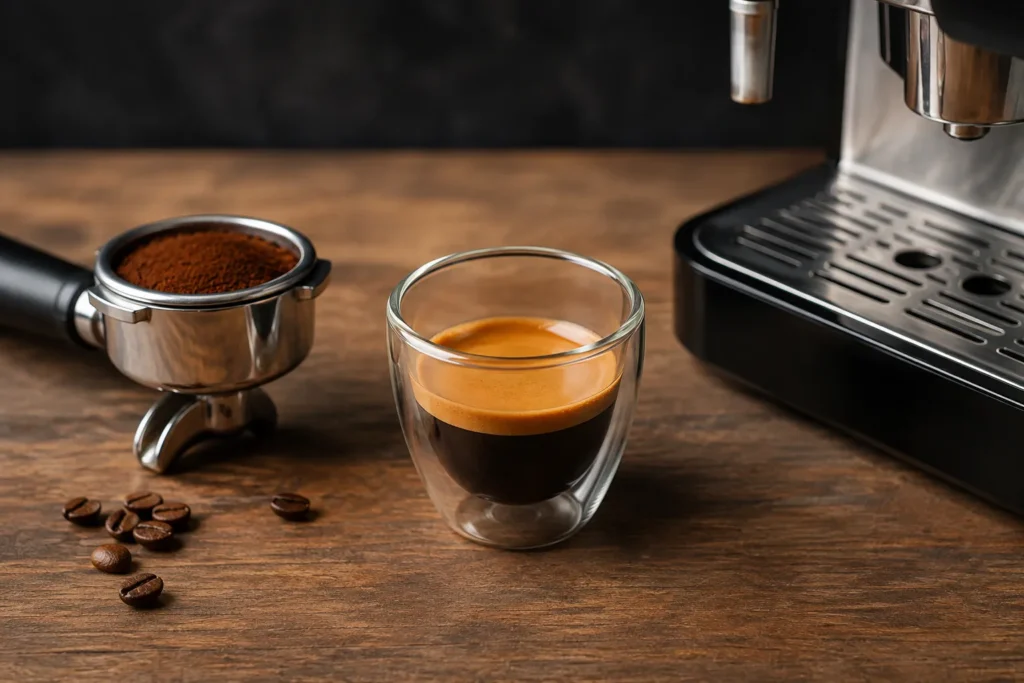
Double Espresso Recipe
- Use 14–18 g of freshly roasted coffee beans. Grind them finely for espresso.
- Place the ground coffee into a double portafilter and distribute it evenly.
- Tamp the coffee firmly and evenly to create a flat, compact coffee puck.
- Lock the portafilter into the espresso machine and start the shot.
- Aim for approximately 50–60 ml (1.7–2 oz) of espresso in 25–30 seconds.
- A properly extracted double espresso should have a thick, golden-brown crema.
- Serve the double espresso immediately after extraction for the best flavor and aroma.
History of Single and Double Espresso
Espresso has its roots in Italy, where coffee-machine technology developed rapidly during the late 19th and early 20th centuries. The modern espresso did not appear as the result of one invention. Its development involved several inventors, machine designs, and technical improvements that gradually changed how coffee could be prepared and served.
The Origin of Espresso
The origin of espresso is closely connected to Italy’s growing coffee culture and the demand for faster coffee preparation. During the 19th century, coffee was already widely consumed in Europe, but traditional brewing methods were relatively slow.
Italian inventors began experimenting with pressure, steam, boilers, and mechanical systems to shorten the brewing process. Their goal was not initially to create the exact espresso served by modern cafés. Instead, they were trying to develop a practical machine capable of producing coffee more quickly and efficiently.
This experimentation eventually led to the technology that made individual espresso shots possible.
Angelo Moriondo and the Early Espresso Machine
One of the earliest important names in espresso machine history is Angelo Moriondo of Turin.
In 1884, Moriondo patented a steam-powered coffee machine. His design was considerably different from today’s espresso machines, but it represented an important technological step toward pressure-based coffee preparation.
Moriondo’s machine was designed primarily for preparing relatively large quantities of coffee. It was not the small, individual-serving espresso machine commonly associated with Italian cafés today.
For this reason, describing Moriondo simply as “the inventor of espresso” is misleading. His contribution is better understood as one of the earliest major steps in the development of the espresso machine.
Luigi Bezzera and Individual Servings
The technology continued to develop at the beginning of the 20th century.
Luigi Bezzera, another Italian inventor, worked on ways to make coffee preparation faster and more practical for individual servings. His machine designs introduced important features that became associated with later espresso equipment.
This development was particularly significant because it brought the idea of preparing a coffee directly for an individual customer closer to the form of the modern single espresso.
Instead of producing coffee mainly in larger quantities, the machine could be used to prepare individual portions more efficiently.
Desiderio Pavoni and Commercial Development
In 1903, Desiderio Pavoni acquired Bezzera’s patents and continued developing the technology.
Pavoni played an important role in turning espresso-machine technology into a commercially viable product. Improvements to the machines made them more practical for cafés, where speed and consistency were important.
By the early 20th century, espresso machines were becoming increasingly associated with Italian coffee establishments.
The development of these machines also influenced the meaning of espresso as a café beverage: a small serving of concentrated coffee prepared quickly for an individual customer.
The Development of Espresso in Italian Cafés
As espresso machines became more practical, they began to influence Italian coffee culture.
The Italian café became an important environment for espresso. Customers could order a small coffee, have it prepared quickly, and drink it without the long brewing process associated with many traditional coffee methods.
This helped establish the espresso shot as a distinct style of coffee preparation.
The exact size of an espresso was not always standardized. Coffee doses, extraction methods, machine designs, and serving sizes varied between periods and locations.
That is why historical descriptions of a “single espresso” should not be treated as if one universal recipe existed throughout the entire history of espresso.
From Steam Pressure to Higher-Pressure Extraction
Early espresso machines relied heavily on steam pressure. Although these systems made fast coffee preparation possible, they did not provide the same extraction characteristics as modern espresso machines.
The next major developments focused on increasing and controlling brewing pressure.
Mechanical systems, particularly lever and piston machines, allowed baristas to generate considerably higher pressure than early steam-based machines.
This change had a major effect on espresso’s appearance and flavor.
Achille Gaggia and the Development of Crema
One of the most important figures in the evolution of modern espresso was Achille Gaggia.
After World War II, Gaggia developed a lever-operated system that used a spring piston to generate higher brewing pressure.
This technology changed the character of the resulting coffee. Higher-pressure extraction helped produce the golden layer now known as crema.
Crema became one of the visual characteristics associated with modern espresso.
The development was important because espresso was no longer simply coffee prepared quickly by a machine. It was becoming a distinct beverage with its own extraction characteristics, texture, aroma, and appearance.
The Rise of the Modern Espresso Machine
Lever machines represented a major improvement, but espresso-machine development continued.
Manufacturers worked on ways to make pressure more consistent and reduce the physical effort required from the barista.
This eventually led to pump-driven espresso machines.
One of the most influential machines in this period was the Faema E61, introduced in 1961.
The E61 used a motor-driven pump to generate brewing pressure and incorporated technologies designed to improve temperature management.
Its design had a lasting influence on commercial espresso machines and helped establish many of the principles still found in modern equipment.
The History of the Single Espresso
The single espresso developed alongside these technological changes.
The basic concept is straightforward: a relatively small amount of finely ground coffee is prepared as one concentrated serving.
However, there has never been one universal definition of the single espresso in terms of dose and final volume.
Traditional Italian espresso and modern specialty coffee can use noticeably different recipes.
A traditional approach may use a relatively small coffee dose, while modern specialty coffee often measures espresso by weight and uses a brew ratio to control the extraction.
For example, a modern recipe might use approximately 8 g of coffee for a single shot, but the exact dose depends on the basket, coffee, machine, and brewing style.
Therefore, the modern concept of a single espresso is better understood as a single serving of espresso, rather than a beverage with one fixed recipe that has remained unchanged throughout history.
The History of the Double Espresso
The double espresso, commonly called a doppio, developed from the same espresso tradition.
Unlike the espresso machine itself, the double espresso does not have a clearly documented single inventor or a specific date of invention.
Its basic idea is simple: use a larger coffee dose to produce a larger espresso serving.
As espresso machines evolved, larger filter baskets and more capable brewing systems made it practical to prepare a double shot consistently.
A traditional double espresso generally uses approximately twice the coffee dose associated with a single shot.
Modern specialty coffee often uses a recipe such as:
18 g coffee → 36 g espresso
This is a 1:2 brew ratio, although many cafés use different ratios depending on the coffee and desired flavor.
What Does “Doppio” Mean?
The Italian word doppio means double.
In coffee terminology, a doppio refers to a double espresso.
The term does not describe a different brewing technology. It describes the size of the espresso serving and the amount of coffee used.
This distinction is useful because a double espresso is sometimes misunderstood as simply adding more water to a single shot.
A properly prepared double espresso normally involves a larger dose of ground coffee and an appropriate extraction yield, rather than simply diluting a single espresso.
Single Espresso and Double Espresso Today
Today, both single and double espresso are widely used in cafés around the world.
The single shot remains a traditional way to serve espresso on its own, while the double shot is extremely common as the foundation for espresso-based drinks.
A double espresso is frequently used in:
- Cappuccino
- Latte
- Americano
- Flat White
- Macchiato
- Cortado
Modern specialty coffee has also changed how espresso is measured.
Instead of judging an espresso only by its volume in milliliters, baristas commonly measure the coffee dose and beverage yield by weight.
This provides greater consistency because crema contains a significant amount of gas and can make volume measurements less reliable.
How Espresso Changed Over Time
The history of espresso can be viewed as a gradual transition through several technological stages:
Steam powered machines
- Individual serving machines
- Commercial café machines
- Lever and piston systems
- Pump driven machines
- Temperature controlled modern machines
At the same time, the coffee itself changed.
Improvements in roasting, grinding, coffee processing, water quality, and extraction measurement allowed espresso to become more precise.
- Coffee origin
- Roast level
- Grind size
- Dose
- Water temperature
- Brewing pressure
- Extraction time
- Beverage yield
- Brew ratio
These variables allow a barista to adjust an espresso recipe according to the characteristics of the coffee.
Espresso From Italy to Global Coffee Culture
Espresso eventually moved far beyond Italy.
As Italian coffee culture spread internationally, espresso became the foundation for many of the drinks served in modern cafés.
At the same time, different countries developed their own serving styles and coffee traditions.
Today, espresso is used in both traditional Italian cafés and modern specialty coffee shops.
The equipment may range from a traditional lever machine to a highly automated commercial system, but the fundamental principle remains the same: hot water is forced through finely ground coffee under pressure to produce a concentrated coffee beverage.
The Evolution of Espresso in One Timeline
1884 Angelo Moriondo
An early steam-powered coffee machine was patented in Turin.
1901 Luigi Bezzera
Important improvements brought espresso-machine technology closer to individual coffee preparation.
1903 Desiderio Pavoni
Pavoni acquired Bezzera’s patents and contributed to the commercial development of espresso machines.
Early 20th century
Espresso machines became increasingly established in Italian cafés.
1940s Achille Gaggia
Lever and piston technology enabled higher-pressure extraction and contributed to the development of modern crema.
1961 Faema E61
The introduction of the E61 represented an important step toward modern pump-driven espresso machines.
Modern era
Digital controls, temperature management, precision grinders, scales, and specialty-coffee techniques have made espresso preparation more measurable and consistent.
Single and Double Espresso in Perspective
The history of single espresso and double espresso is therefore part of the larger history of espresso-machine development.
The single espresso represents the traditional idea of a small individual serving, while the double espresso, or doppio, provides a larger serving using a greater coffee dose.
Neither has one fixed recipe that applies to every period or country. Modern recipes are influenced by the equipment, coffee, roast, grinder, basket, and brewing philosophy being used.
Summarize this blog post with:
One Response
Very Nice Double Espresso Recipe step by step . Tank you website😍